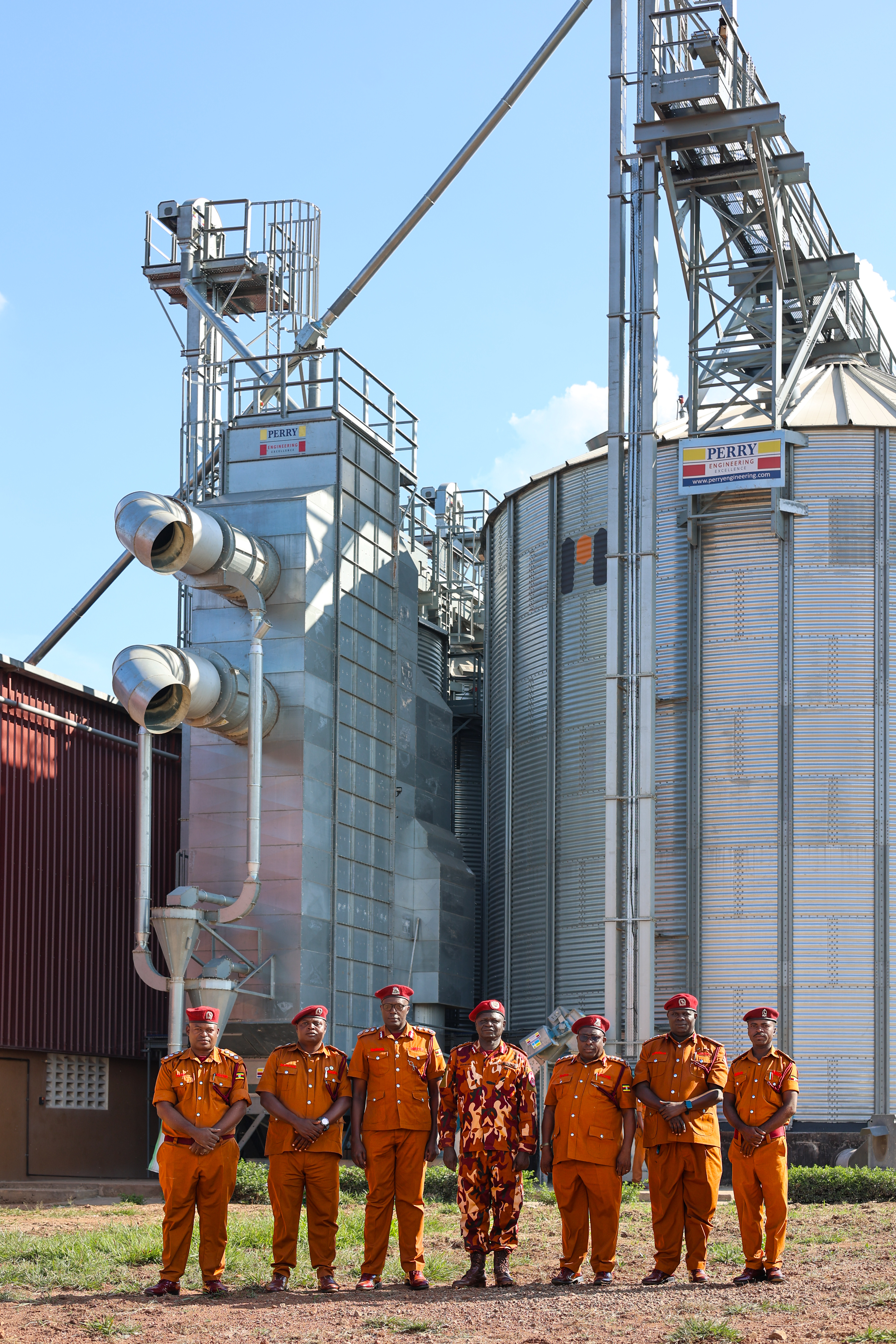
GULU DISTRICT, August 25, 2026 —The Uganda Prisons Service (UPS) is strengthening its contribution to food security in Northern Uganda through modern agricultural production, grain storage and value addition at its Logore Prison Farm in Gulu District.
The Deputy Commissioner General of Prisons, Mr Samuel Akena, inspected operations at the 3,000-metric-ton grain storage and processing facility at Logore Prison Farm, where he was taken through the different stages of grain handling, storage and processing.
Mr. Akena was accompanied by Senior Commissioner of Prisons Frank Baine, in charge of Corporate Affairs and Service Spokesperson, and Commissioner of Prisons Apollo Akankunda, in charge of National, Regional and International Cooperation.
The facility provides a complete system for handling maize, including cleaning, drying, storage and processing, allowing grain to be preserved for long-term use while maintaining its quality.
The grain management system uses modern technology and automated processes supported by specialized software applications. The machinery operates on a three-phase power supply, with a 275 KVA generator providing backup power to ensure uninterrupted operations.
The facility also has systems for monitoring grain quality and storage conditions. These include moisture monitoring, temperature control, carbon dioxide monitoring, fumigation and checks for aflatoxins, helping to protect the grain from contamination and spoilage.
After storage, the grain can be discharged, cleaned and packaged in 100-kilogram bags, providing an organised system for distribution and use.
During the inspection, the Deputy Commissioner General was also taken through the operations of the weighbridge, as well as alternative energy sources supporting activities at the farm.
Supporting Food Security
The investment forms part of the Uganda Prisons Service’s wider agricultural programme aimed at contributing to food security, particularly in Northern Uganda.
By increasing grain production, improving storage capacity and adding value to agricultural produce, the Service is helping to reduce post-harvest losses and ensure that food produced in the region can be safely preserved and used when needed.
The maize milling plant at Logore further strengthens this intervention by processing maize into flour. The flour is intended to support feeding programmes for inmates and staff serving the three regions in the greater northern part of the country.
This approach enables the Service to move beyond simply producing food to storing, processing and adding value to agricultural produce, creating a more sustainable food supply chain.